Corporate Govemance
01Corporate Govemance
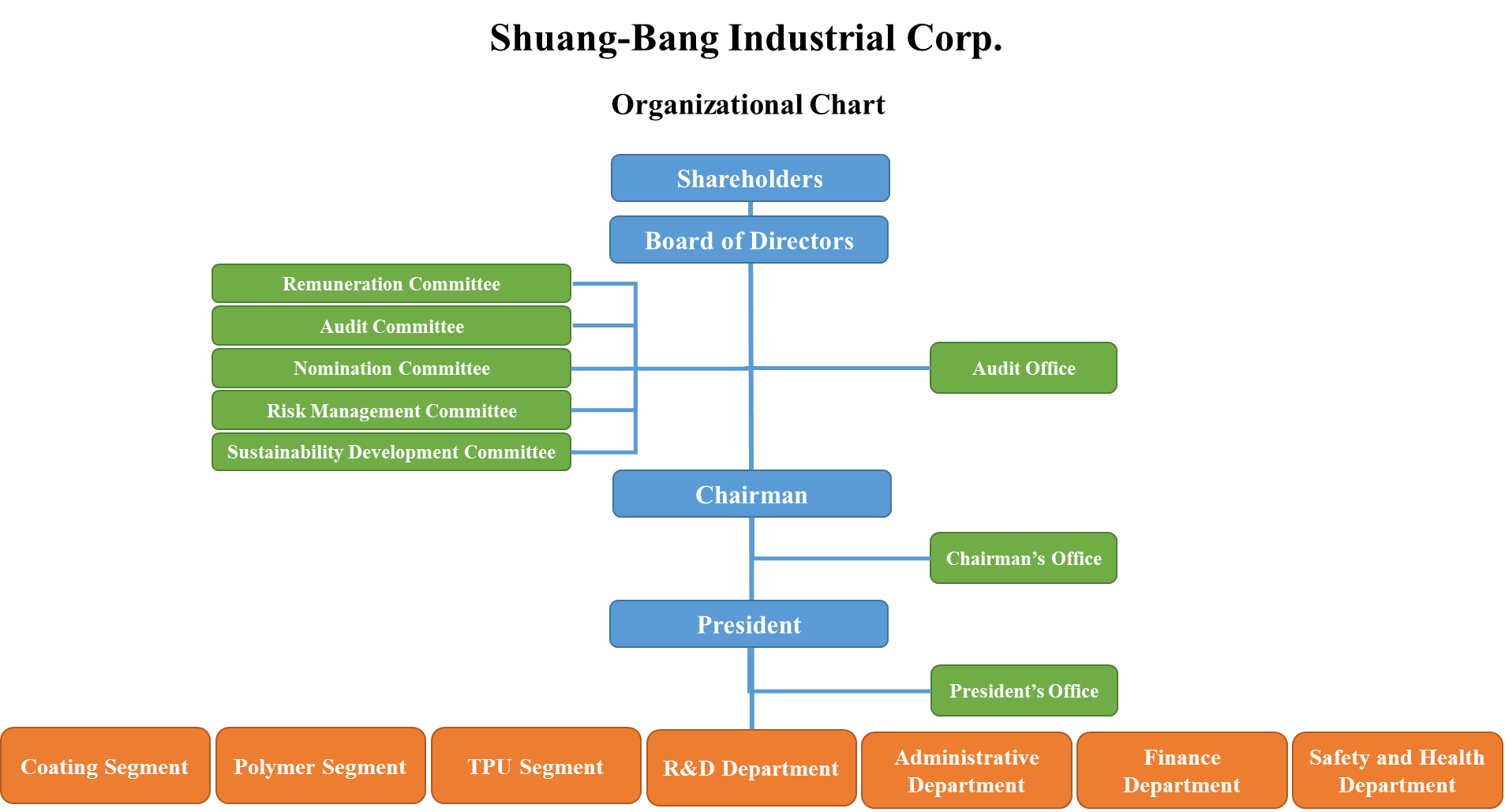
The Board of Directors of Shuang-Bang Industrial Corp. is the Company’s highest governance body. It has established the Audit Committee, Compensation Committee, Nomination Committee, Risk Management Committee, and Sustainability Development Committee to assist in fulfilling its supervisory responsibilities and to report their activities, proposals, and related resolutions to the Board. In terms of sustainability strategy management, the Board of Directors serves as the highest decision-making and supervisory body for managing impacts related to economic, environmental, and social issues. When deliberating significant matters, the Board takes into account governance, environmental, and social issues, their related impacts, risks and opportunities, as well as stakeholder perspectives.
02Functional Committee
The Board of Directors of Shuang-Bang Industrial Corp. has established the Audit Committee, Compensation Committee, Nomination Committee, Risk Management Committee, and Sustainability Development Committee to assist the Board in fulfilling its supervisory responsibilities. The organizational charters of all committees are approved by the Board of Directors.
| Audit Committee | Remuneration Committee | Nomination Committee | Risk Management Committee | Sustainability Development Committee |
|---|---|---|---|---|
To strengthen organizational value, enhance supervisory functions, and ensure sound financial review and control, the “Audit Committee Charter” was adopted and the Audit Committee was established to support the Company in achieving its strategic objectives. |
In accordance with the Regulations Governing the Establishment and Exercise of Powers of Remuneration Committees of Companies Whose Stock is Listed on the Taiwan Stock Exchange or Traded Over the Counter by Securities Firms, the “Remuneration Committee Charter” was adopted. The Remuneration Committee was established in December 2011 to ensure a sound compensation system for directors and managers. |
To strengthen the Board’s functions and enhance governance mechanisms, the “Nomination Committee Charter” was adopted in accordance with the Corporate Governance Best-Practice Principles for TWSE/TPEx Listed Companies. The Nomination Committee was established in November 2024. |
To establish a risk management mechanism and strengthen corporate governance, the “Risk Management Committee Charter” was adopted in accordance with Article 27 of the Corporate Governance Best-Practice Principles for TWSE/TPEx Listed Companies. The Risk Management Committee was established in November 2024. |
To achieve sustainability objectives and effectively promote sustainability initiatives, Shuang-Bang established the Sustainability Development Committee in 2022 as the decision-making and supervisory body for sustainability-related matters. To further strengthen sustainability governance, the Committee was restructured in December 2024, and the “Sustainability Development Committee Charter” was adopted. In March 2025, the Board of Directors approved the revised structure, designating the Board as the highest governance body of the Sustainability Development Committee. |
Functional Committee Member
| Title | Name | Term of Service (Year) |
Audit Committee |
Remuneration Committee |
Risk Management Committee |
Nomination Committee |
Sustainability Development Committee |
Main academic and career backgrounds |
|---|---|---|---|---|---|---|---|---|
| Independent Director | Chen, Li-Ling | 0.5 | ● | ● | ○ | ○ | ○ | Education: PhD of Accounting, National Cheng Kung University Experience: CPA, Chuan-Da Accounting Firm Manager, Audit Department, KPMG Independent Director, Hanpin Electron Co., Ltd. Independent Director, Lin Horn Technology Co., Ltd. Assistant Professor, Tatung Institute of Technology |
| Independent Director | Tsai, Hao-Chin | 0.5 | ○ | ○ | ○ | ● | ○ | Education: Master of Industrial Engineering, University of Houston Experience: President, ChingTai Resin Chemical Co., Ltd. Director, ChingTai Resin Chemical Co., Ltd. |
| Independent Director | Cheng-Feng Cheng | 3.5 | ○ | ○ | ● | ○ | Education: Ph.D. in Chemistry, University of North Texas Experience: Professor of Chemistry, National Chung Hsing University Vice President of National Chung Hsing University |
|
| Chairman | Chung-Tang Chang | 36 | ● | Education: Department of Chemistry, National Chung Hsing University Experience: Chairman, Shuang-Bang Industrial Corp. |
Note 1: ● Convener; ○ Member.
Note 2: All members of functional committees possess more than five years of work experience and relevant qualifications, sufficient to maintain the independence, professionalism, and impartiality of the functional committees.
| Functional Committee | Responsibilities | Actual governance |
|---|---|---|
| Audit Committee |
|
A total of five meetings were held in 2024, and all members attended the meeting in person, with an average attendance rate of 100%. |
| Remuneration Committee |
|
A total of three meetings were held in 2024, and all members attended the meeting in person, with an average attendance rate of 100%. |
| Nomination Committee |
|
A total of two meetings were held in 2024, and all members attended the meeting in person, with an average attendance rate of 100%. |
| Functional Committee | Responsibilities | Actual governance |
|---|---|---|
| Risk Management Committee |
|
A total of one meeting was held in 2024, and all members attended the meeting in person, with an average attendance rate of 100%. |
| Sustainability Development Committee |
|
In December 2024, the committee was restructured and has not yet convened a formal meeting. The Corporate Governance Officer reported the implementation status of sustainability development to the Board of Directors. |
Note 1: Detailed disclosures on the operations of the functional committees have been published in Shuang-Bang Industrial Corp.’s 2024 Annual Report, and can be accessed through the Market Observation Post System (MOPS) and on the Company’s website (https://www.shuang-bang.com).
03Ethical Corporate Management
Shuang-Bang Industrial Corp. firmly believes that ethical corporate management is a fundamental cornerstone for sustainable operations. By fostering a culture of integrity and establishing a comprehensive ethical management framework, the Company strives to achieve the goal of ethical corporate conduct. To implement its ethical management policy and actively prevent dishonest behavior, Shuang-Bang has formulated the Ethical Corporate Management Principles, Procedures for Ethical Management and Guidelines for Conduct, Director and Manager Ethical Behavior Guidelines, and Procedures for Handling Internal Material Information. These serve as the standards of ethical compliance for directors, managers, and employees, as well as a basis for enhancing behavioral standards. In addition, the Company arranges annual training courses for directors and supervisors, and promotes ethical values and related regulations through executive meetings and monthly meetings, ensuring that all employees clearly understand the Company’s philosophy and requirements regarding ethical corporate management.
| Management Regulations | Regulated Target | Regulated Conduct |
|---|---|---|
| Ethical Corporate Management Principles | Directors, supervisors, managers, employees, appointees, and individuals with substantial control over the Company. |
|
| Procedures for Ethical Management and Guidelines for Conduct | Directors, supervisors, managers, employees, appointees, and individuals with substantial control over the Company. |
|
| Director and Manager Ethical Behavior Guidelines | Directors and managers, including the President and equivalent positions, Vice Presidents and equivalent positions, Assistant Vice Presidents and equivalent positions, the head of the Finance Department, the head of the Accounting Department, and other individuals responsible for corporate management who are authorized to sign on behalf of the Company. |
|
The detailed provisions of ethical corporate management regulations are publicly disclosed on Shuang-Bang Industrial Corp.’s official website under “Important Internal Regulations”
H.Q.: No.3, Yongsing Rd., Nangang Industrial Dist., Nantou City (540), Taiwan, R.O.C.
TEL:049-2257450 FAX:049-2257436
Renhe: No.155, Renhe Rd., Nangang Industrial Dist., Nantou City (540), Taiwan, R.O.C.
TEL:049-2251505 FAX:049-2251507
NanGang: No. 101, Nangang 3rd Rd., Nangang Industrial Dist., Nantou City (540), Taiwan, R.O.C.
TEL:049-2255970 FAX:049-2257590
TPE office: 2F-3, No. 22-2, Ningxia Rd., Datong Dist., Taipei City (103) Taiwan, R.O.C.
TEL:02-25506279 FAX:02-25501707
 Shuang-Bang Industrial. Corp.© 2017